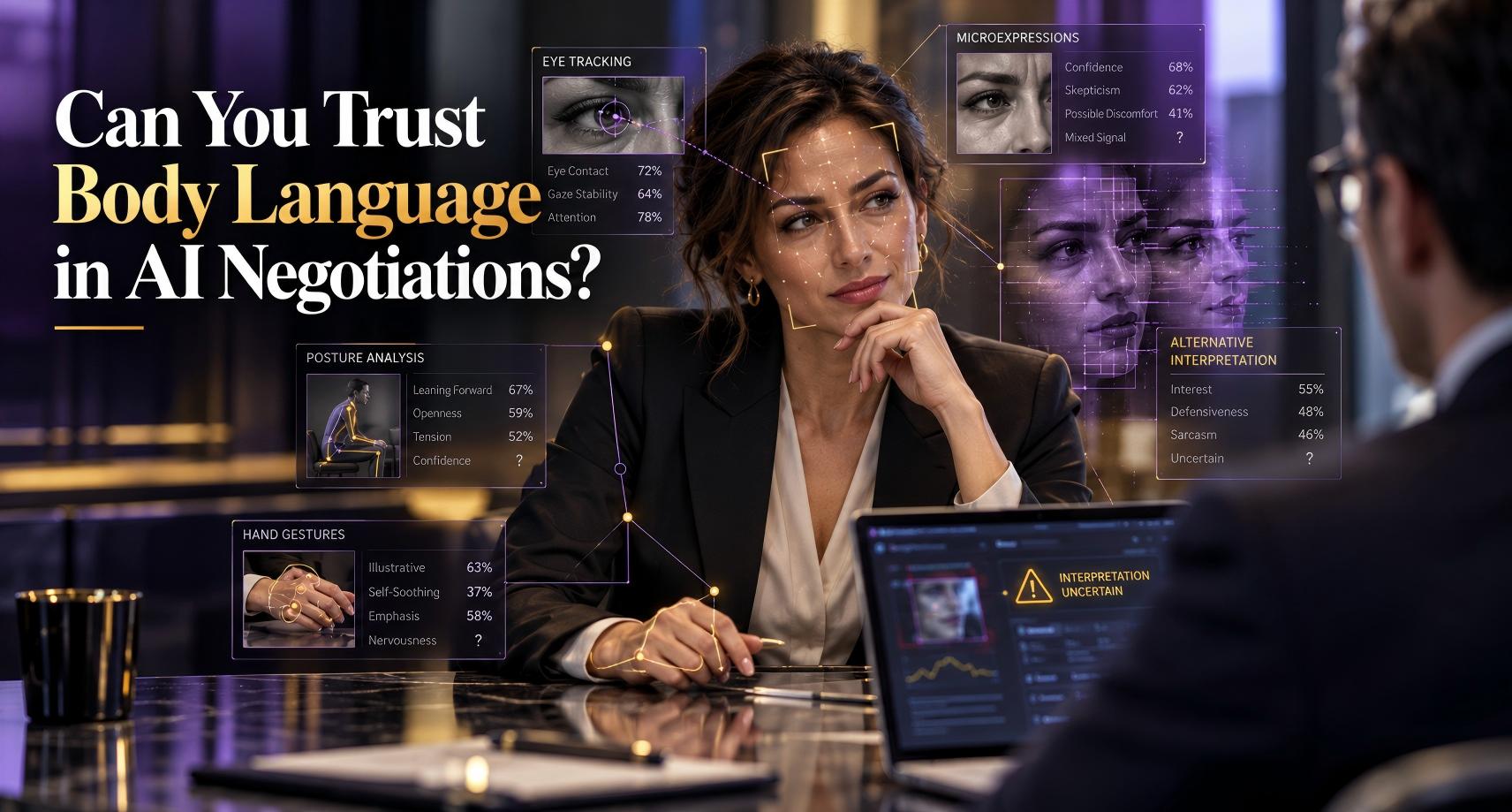
“It’s okay to leverage AI in negotiations, but be mindful of it leveraging you.” -Dr. Greg Williams, The Master Negotiator & Body Language Expert

“4 More New AI Negotiation Truths – How to Protect Your Winning Skills”
Artificial intelligence (AI) has emerged as a significant force in negotiations, offering the prospect of expedited deals, data-driven foresight, and coherent processes. However, beneath the surface of these advancements exists a concealed reality: an excessive dependence on AI can gradually diminish a negotiator’s skills and abilities during negotiations. Some international companies already let autonomous agents negotiate and renegotiate thousands of low-value contracts, reporting enormous savings.
An autonomous negotiation agent is an AI model that can negotiate deals or contracts on behalf of an entity without human intervention. They use algorithms and strategies to interact with other parties to achieve desired outcomes, such as better prices, favorable terms, or agreements for the agent’s owner.
This article outlines four possible hidden threats and provides guidance on utilizing AI while maintaining the subtlety, creativity, and connections necessary for securing intricate agreements.
Potential Threat #1: Tunnel Vision Driven by Data
Modern negotiation agents learn from vast historical datasets. While this enhances pattern recognition, it encourages negotiators to rely on probability tables rather than accurately assessing the room’s dynamics. I emphasize observing more negotiation truths through body language here è https://bit.ly/3EdHgKr
Research indicates that bots routinely reveal their own bottom lines when pressured, a mistake seasoned negotiation professionals avoid. Note that bots follow a predetermined, scripted path, and AI agents function based on reasoning.
However, simply adhering to AI-generated offers may trap negotiators in scripted actions that overlook real-time micro-expressions in body language, potentially altering the power dynamics in negotiations.
Self-Protection: Utilize AI as a forecasting tool before negotiations. If emotions heighten during the talks, switch to human-led intervention. Capture nuances (tone, posture, verbal hesitation) and incorporate them into post-negotiation AI debriefs for continuous improvement.
Potential Threat #2: Loss of Motivation and Empathy
Although generative AI can enhance productivity, it can also decrease motivation and increase monotony when people return to non-automated negotiations. Negotiators who outsource preparation, option generation, or even scripted openings to large language models (LLM) risk deadening their empathic control; the perspective of reading negotiation counterparts to make appropriate adjustments.
Self-Protection: Maintain control of brainstorming to create value. Employ AI to automate activities like summarizing counterpart disclosures or simulating greater negotiation outcome (GNO) scenarios. This will safeguard your empathetic abilities from diminishing and protect your creative instincts from dulling.
Potential Threat #3: Amplified Bias and Blighted Ethical Perspective
LLMs contain historical biases within their training data. Studies in finance, mortgage lending, and human resources possess documented discriminatory evidence against some ethnicities. In certain instances, AI exhibited human cognitive biases, ranging from confirmation bias to the hot-hand fallacy (i.e., if successful, success will continue).
Self-Protection: Evaluate negotiation-support models using counterfactual prompts (e.g., “Would your advice differ if the supplier were a woman-owned business?”). Verify that AI’s proposals are not against your ethical standards before presenting them.
Potential Threat #4: Skill Decline Due to Delegation
When AI drafts your concessions and their timeframes, scripts your persuasive framing, and determines your Increased Negotiation Outcome (INO) boundaries, you risk leaning too heavily on that and lessening your time to practice. Just as spellcheckers have transformed how we approach writing, fully autonomous negotiation agents could potentially dull negotiators’ natural instincts, curiosity, and their capacity to convey warmth and confidence. Research has shown that these unique human qualities often outperform the purely rational responses generated by bots in experimental settings.

Self-Protection: Keep People Involved in AI Policy
- Pre-negotiation: Humans establish goals and authorize AI analytics.
- Live negotiation: AI acts as a quiet coach, displaying real-time prompts and choices on a screen as negotiators guide the conversation.
- Post-negotiation: AI generates a report detailing lessons learned; negotiators provide annotations regarding subjective dynamics that were overlooked.
Turning AI into a Multiplying Power
| Objective | AI’s Role | Your Role |
| Pattern discovery in high-volume data | Mine clauses, detect pricing anomalies | Define which patterns matter strategically |
| Scenario rehearsal | Simulate “if-then” paths | Rate realism, inject emotional variables |
| Real-time cueing | Flag silence length, sentiment shifts | Decide whether to probe, pause, or concede |
| Post-deal debrief | Produce transcript analytics | Interpret context, update playbook |
By viewing AI as an advisor rather than an agent, negotiators maintain the art of negotiation while leveraging its scientific aspects.

Reflection
Whether leading a global procurement team, managing a start-up, or negotiating alone, AI’s negotiation boom presents a crucial imperative: control the tool before it controls you. For corporations, this means keeping humans in the loop to ensure automated contracts do not erode brand trust.
Small-business owners can utilize affordable AI tools to uncover market insights while ensuring personal relationship-building to stand out from larger competitors.
Independent negotiators may combine AI analytics with genuine storytelling to excel beyond their means, seeking to transform data-rich insights into empathy-driven agreements. This will ensure the negotiation agreement is adhered to. And everything will be right with the world.
Remember, “You’re always negotiating!”
I would love to hear from you: What negotiation mistakes have you witnessed or experienced? What questions do you have about AI in negotiations? Share your thoughts in the comments and join the conversation!
Listen to Greg’s podcast at https://megaphone.link/CSN6318246585
After reading this article, what are you thinking? I’d like to know. Reach me at Greg@TheMasterNegotiator.com
To receive Greg’s free “Negotiation Tip of the Week” click here https://www.themasternegotiator.com/negotiation-speaker/ and sign up at the bottom of the page