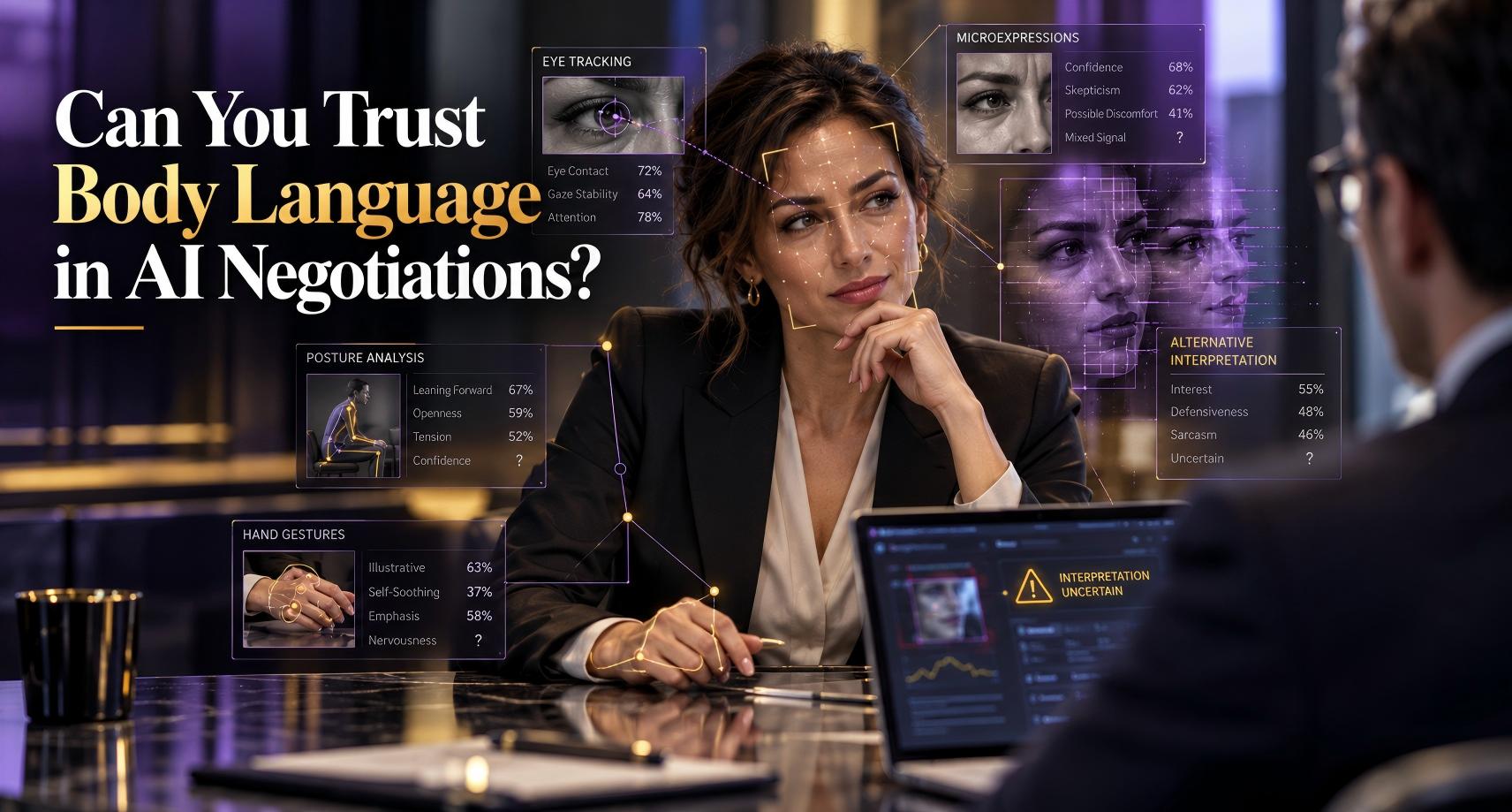
AI reveals patterns and calculates outcomes; humans create meaning and meaning closes deals.” -Dr. Greg Williams, The Master Negotiator & Body Language Expert
.

.
“The Negotiator’s Advantage in an AI World:
What Machines Still Can’t Do”
.
The Future of Negotiation: AI, Emotional Intelligence, and Human Advantage
Will AI replace negotiators? The better question is: who will be replaced first, those who ignore AI, or those who use it without understanding people?
Negotiation is entering a new era where preparation becomes machine-assisted, while influence remains profoundly human. The professionals who win won’t use AI; they’ll combine AI-driven clarity with emotional intelligence, timing, and authentic presence.
How AI upgrades preparation, analysis, and scenario testing
AI changes preparation by turning raw information into a usable strategy. It can summarize prior communications, map stakeholders, detect inconsistencies in positions, and surface likely constraints. It can also help quantify options and the downstream impact of concessions.
Most importantly, AI can run scenario tests quickly: “If they reject term A, what’s the best counter that preserves value?” or “Which bundle protects margin while improving their perceived gain?” That speed matters because it frees the negotiator to focus on decision quality instead of data hunting.
A surprising insight from AI-assisted simulations
When you simulate thousands of negotiations, one counterintuitive result shows up repeatedly: the most dominant approach often underperforms over multiple rounds. High-pressure tactics can win a battle, but they frequently lose the relationship, raise defensiveness, and shrink future cooperation.
Simulations tend to reward strategies that are firm on objectives and flexible on methods, especially when value can be created through trades (e.g., timing, scope, risk-sharing, or non-monetary terms). In practice, AI doesn’t make you softer; it makes you more precise about when to press and when to pivot.
Why emotional awareness remains the human advantage
AI can estimate sentiment, but it cannot truly experience emotion, detect a silent identity threat, or sense when trust has shifted in the room. Humans negotiate with history: pride, fear, status, and the need to feel respected. Emotional awareness lets you recognize when logic is no longer the driver, and when the real negotiation is about respect, certainty, or control.
That’s where body language, tone, pacing, and micro-reactions become decisive. The best negotiators read the moment and adjust, slowing down to reduce threat, reframing to protect identity, or asking a calibrated question that gives the other party a dignified path forward.
Using AI as a sparring partner without losing authenticity

AI becomes most valuable when used as a training counterpart. You can rehearse difficult conversations, practice responses to objections, and test multiple phrasing options until you find language that fits your voice. Use it to pressure-test your plan: “What would a skeptical CFO attack?” “How would a procurement lead reframe this?” Then refine your approach.

The rule is simple. Never outsource your authenticity. Let AI challenge your thinking; don’t let it speak for your character. Real influence requires congruence; what you say must match how you show up.
The next evolution of strategic influence
Strategic influence is evolving into a dual capability. First: analytical intelligence, supported by AI that expands options, predicts friction points, and clarifies tradeoffs. Second: relational intelligence, where you create trust, manage emotion, and guide outcomes through presence and timing.
Negotiators who master both will move beyond tactics into orchestration, knowing what to offer, when to offer it, and how to frame it so the other side wants to agree.
Will AI replace negotiators?
AI will not replace negotiators. It will replace unprepared negotiators, and it will expose negotiators who lack emotional control. The human advantage is not intuition alone; it is self-awareness, empathy, and the ability to influence under pressure. AI amplifies competence, but it cannot replace character, credibility, and connection.

A future-facing challenge

In the next 30 days, run three AI simulations of a negotiation you expect to face. Identify the best alternative path you hadn’t considered. Then practice delivering it with full authenticity, steady tone, clean language, and disciplined emotional control.
The future isn’t coming. It’s already at the table. What human advantage will you strengthen before the next deal tests you?
Reflection
The future of negotiation belongs to those who combine AI-driven insight with human emotional intelligence, turning technology into a strategic ally while preserving authenticity, trust, and influence. Master both dimensions, and you won’t just adapt to change, you’ll lead it. And everything will be right with the world.
Remember, “You’re always negotiating!”
If this resonates with you, drop me a comment at Greg@TheMasterNegotiator.com
Listen to Dr. Greg’s podcast at https://megaphone.link/CSN6318246585
After reading this article, what are you thinking? I’d like to know. Reach me at Greg@TheMasterNegotiator.com
To see more of Dr. Greg’s “Negotiation and Body Language Tips,” click here https://www.themasternegotiator.com/blog